
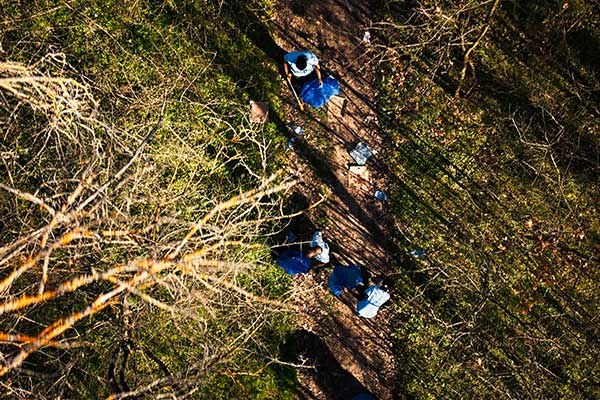
Underbrush clearing keeps the trees and removes what has grown up beneath them, which on most New Braunfels properties is exactly what the owner wants. What is worth keeping varies across the city. West of town it is live oak mottes and Spanish oaks. Along the rivers it is bald cypress and pecans. East and south it is post oaks and bottomland hardwoods. The service is the same, the judgment is local.
Out goes cedar in the understory on the west side, and hackberry, chinaberry, ligustrum, tallow, greenbriar, and young mesquite elsewhere, along with deadfall, prickly pear, and volunteer growth crowding the base of better trees. Staying are live oaks, Spanish oaks, post oaks, pecans, cedar elms, and any specimen tree you point at. Along the rivers, the cypress stay without discussion. We mark keepers with you before anything begins.
Property along the Comal and the Guadalupe carries the best trees in the city and the most sensitive ground. Bald cypress along these banks are irreplaceable, some of them are very old, and the root systems and bank structure they hold are what keeps the bank where it is. Understory work down there is done by hand and with minimal machine traffic, and we do not remove vegetation that is holding a bank together simply because it is in the way of a view.
Work near the rivers can involve floodplain considerations and, depending on scope and location, other requirements as well. Clearing riparian vegetation is not the same as clearing a back yard, and it should not be approached the same way. Before any significant work along a bank, confirm your floodplain status and check with the city on what applies. We would rather establish that first than have you find out afterward.
The bottomlands here carry good pecans, and a mature pecan with brush grown up around its base is competing for water and impossible to work under or harvest near. Clearing beneath them improves airflow, makes the ground usable, and lets you actually see the condition of the trees. It is inexpensive relative to what a mature pecan is worth, and on properties with productive trees it is one of the better investments available.
Comal County sits inside the oak wilt region and live oaks are root grafted, often across property lines. The disease travels through those connections and through beetles drawn to fresh wounds, so the standard guidance applies: avoid wounding oaks during the high risk window in late winter and spring, and paint any wound that does occur the same day. Understory work should not be wounding oaks at all, but the precaution stands.
West of the escarpment, cedar understory removed properly stays down and returns slowly from seed. East and along the bottoms, the understory species mostly resprout from the crown, and full grubbing is often inappropriate near trees you are keeping because it disturbs their roots. That means understory clearing on that side is a maintained condition rather than a permanent one, with a light return visit every year or two.
On larger properties there is no need to open everything at once. Many owners start with the area nearest the house or the section they most want back, then work outward over a season or two. That spreads the cost, lets you see how the ground responds, and gives a realistic sense of the regrowth rate before committing to the rest, which matters more east of the escarpment where resprouting is the norm.
Understory along the river corridors and in the bottomlands reliably includes poison ivy, often climbing well up the trunks where nobody notices it until they are already in it. Crews work with proper protection and it leaves with the debris rather than being chipped, since chipping disperses the oil into the air. Tell us at the walkthrough if you know it is present so we plan for it.
Underbrush clearing across New Braunfels, Gruene, Canyon Lake, Bulverde, Spring Branch, Garden Ridge, Schertz, Cibolo, Seguin, Marion, and throughout Comal and Guadalupe counties.
Tell us which trees matter and what you want to be able to reach. Call 210-942-1961.
Yes, carefully and mostly by hand. River corridor ground carries the best trees in the city and the most sensitive bank structure, and we do not remove vegetation holding a bank together just because it obstructs a view. Confirm your floodplain status and check with the city on what applies before any significant work along a bank.
Not as part of understory work. Bald cypress along the Comal and Guadalupe are irreplaceable, often very old, and their roots are part of what holds the bank. If a cypress is genuinely hazardous that is a separate conversation involving an arborist and, likely, the city. It is not something to decide casually.
It depends on your side of the escarpment. Cedar understory removed west of town stays down and returns slowly from seed. East and in the bottomlands, most understory species resprout from the crown, and grubbing crowns near trees you are keeping is often inappropriate because it disturbs their roots. Expect a maintenance cycle on that side.
Generally yes, and it is inexpensive relative to what a mature pecan is worth. Removing brush from around the base reduces competition, improves airflow, makes the ground workable, and lets you assess the trees properly. On properties with productive pecans it is one of the better investments available for the money.
Underbrush clearing removes growth beneath the canopy and leaves mature trees, soil, and contour alone. Land clearing takes a defined area to bare workable ground including stumps. On most New Braunfels properties where the trees are the reason you bought the place, understory work is the service that produces what you actually want.
Inside city limits the tree code may capture stems larger than you expect, and work near the rivers can carry additional considerations. Selective understory work usually sits comfortably within tree protection rules since the canopy is untouched, but confirm before scheduling rather than assuming brush is unregulated because it is not a mature tree.
It is quoted by the job or by the acre depending on scale, and comes in below full clearing since there is no stump removal or grading. Drivers are understory density, how many keeper trees have to be worked around, how much must be done by hand, and access. River corridor work costs more per acre because more of it is hand work.