
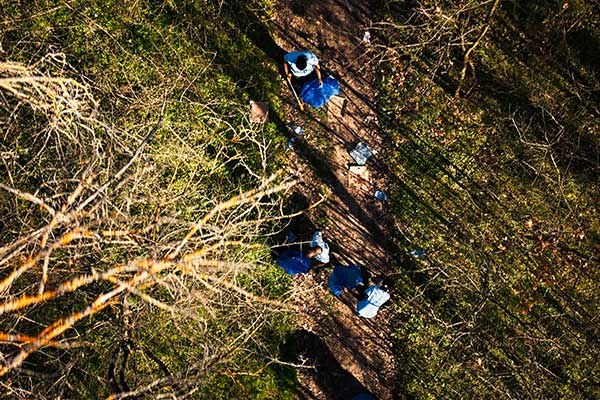
Underbrush clearing is the selective option. Instead of taking a property to bare ground, we remove the tangled growth beneath the canopy and leave the mature trees standing. The result is land you can walk, drive, and actually see across, with the live oaks and shade that made the property worth buying still in place. It is the most requested service we run on Hill Country acreage around San Antonio.
Out goes cedar in the understory, young mesquite and huisache, greenbriar, dead fall, prickly pear, and the volunteer saplings crowding the base of better trees. Staying are mature live oaks, post oaks, Texas red oaks, pecans, cypress along the creeks, and any specimen tree you point at. We mark keepers with you before the first machine starts, and if there is ever a question about a particular tree, we ask rather than guess.
Ashe juniper is the reason most Bexar and Comal county understory work happens. A dense cedar stand intercepts rainfall before it reaches the ground, shades out grass, and competes hard for the water that would otherwise recharge the soil and feed larger trees. Thinning cedar from the understory routinely brings back grass cover within a season or two on land that had nothing growing beneath it. It also removes ladder fuel, which is the material that lets a ground fire climb into the canopy.
Most of this work is done with a mulching head, because it clears standing understory without disturbing soil or the root zones of the trees you are keeping. Larger removals get felled first and then processed. Hand crews with saws go in where equipment cannot fit safely, particularly close to trunks, along fence lines, and around structures. Material is mulched and left as ground cover, which protects the soil and gives the property a finished park like appearance rather than a construction site look.
Oak wilt is a real problem across central Texas and it spreads through fresh wounds during the high risk window in late winter and spring. When we work in oaks during that period, cut and damaged surfaces get painted the same day, and we keep equipment clear of root flares and avoid unnecessary contact with trunks. If your property has a history of oak wilt, tell us during the walkthrough so we can plan the sequence around it.
The two get confused constantly and they produce very different properties. Full clearing removes everything including stumps and root systems and leaves bare, gradeable ground for construction. Underbrush clearing is subtractive within a landscape you are keeping. It costs less per acre, moves faster, does not disturb soil, and does not require the permits or erosion controls that a large land disturbance can trigger. If you are building, you need clearing. If you want to use and enjoy the land you already have, you almost certainly want underbrush work.
The first spring after clearing is when owners see what the property actually is. Grass comes back where nothing grew under cedar shade. Wildflowers show up from a seed bank that has been dormant for years. Deer move differently once there are sight lines and browse at ground level. There will also be regrowth, mostly from resprouting species and from seed in disturbed spots, and it is far easier to handle in year two with a light pass than to let it close in and pay for full clearing again in year eight.
This is not only an acreage service. Wooded half acre and one acre lots around Stone Oak, Shavano Park, and the north side often carry heavy cedar understory that shades the house, blocks the view, and stacks fuel against the structure. On those properties we work with smaller equipment and hand crews, protect the lawn and hardscape, and mulch or haul the material depending on how tidy you need it. The improvement on a small wooded lot is usually more dramatic than on open acreage.
Underbrush clearing across San Antonio, Boerne, Bulverde, Helotes, Fair Oaks Ranch, Spring Branch, Timberwood Park, Garden Ridge, Grey Forest, and throughout Bexar, Comal, and Kendall counties.
Walk us through what you want the land to look like when we leave. That conversation is worth more than any spec sheet. Call 210-942-1961.
It is the selective removal of vegetation growing beneath the tree canopy, including small cedar, saplings, vines, dead fall, and brush, while leaving mature trees untouched. The goal is an open, usable, walkable property that still has its shade and character. It is very different from full land clearing, which removes everything down to dirt.
Done correctly it helps them. Removing understory reduces competition for water and nutrients and improves airflow around trunks. The risks are mechanical damage and oak wilt transmission through fresh wounds, both of which we manage by keeping machines outside root zones where possible and painting oak wounds the same day during the high risk season.
It is normally quoted per acre and comes in below full clearing since there is no stump removal or grading. The cost drivers are how dense the understory is, how many trees have to be worked around, and terrain. Heavily wooded tracts with tight tree spacing take longer per acre than open ground with scattered brush.
Yes. Mulching leaves the soil and root mat undisturbed and covers the ground with chip. Most owners see native grass improve after clearing, because the understory that was shading it out and taking the water is gone. Full recovery depends on rainfall and on whether a seed bank is still present in the soil.
Most San Antonio area properties benefit from a maintenance pass every two to four years, longer where the initial clearing was thorough and the mulch layer is suppressing seed. Cedar returns from seed rather than from stumps, so once the seed source is thinned the regrowth rate drops noticeably compared to the first clearing.
Yes. Trails, interior roads, view corridors, and shooting lanes are common requests on recreational tracts. We can lay them out with you on the ground or work from a marked aerial. Lanes are usually mulched so they stay clean underfoot and drain rather than rutting.
Buyers cannot value what they cannot see. Cleared understory lets a buyer walk the whole tract, see the topography, the tree quality, and the boundaries, and picture a homesite. It is one of the lower cost improvements available for raw land and it changes how the property shows in photographs as well as in person.