
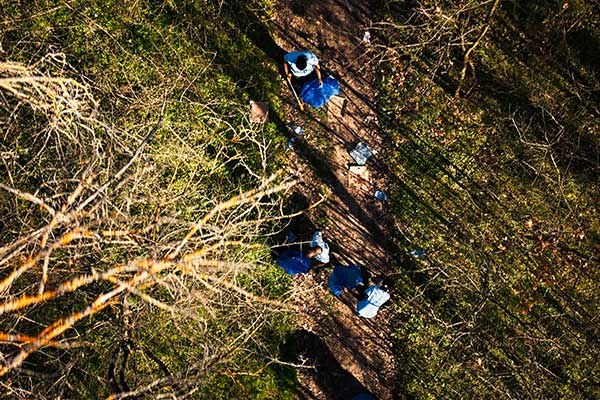
Underbrush clearing here is really landscape restoration by another name. Beneath specimen oaks and pecans that were placed deliberately eighty years ago, the ground level has filled in with ligustrum, nandina, hackberry, and privet until the structure of the garden has disappeared entirely. Taking that out and leaving the trees usually reveals a property that is still, underneath everything, well designed.
This is the part owners are most often surprised by. Clear the overgrowth from a Terrell Hills property and you frequently find the bones of the original design still in place: a stone path, a wall, a terrace edge, a planting bed with its border intact, sometimes a garden feature nobody living remembers. We work carefully in areas where that is likely, because breaking a seventy year old stone edge with a machine is a permanent loss and the whole point of the exercise is to recover what is there.
Out goes ligustrum and privet grown past use, nandina spreading out of old beds, hackberry and chinaberry saplings, greenbriar, poison ivy, English ivy on trunks, and volunteer growth crowding tree bases. Staying are the live oaks, pecans, red oaks, cedar elms, and any original planting still doing its job. That last category is why the walkthrough here takes longer than usual. Some of what looks like overgrowth is eighty year old planting worth keeping, and we would rather ask than assume.
These properties were planted for their trees, and the trees have delivered. A mature live oak or pecan here is irreplaceable in any timeframe that matters to a living owner. Removing the competing understory reduces the draw on water and nutrients and improves airflow, but the real value is simply being able to see them again. Owners regularly tell us they had forgotten what the trunk lines looked like.
English ivy and Virginia creeper climbing an oak or a pecan add weight and wind load, hold moisture against the bark, and hide structural defects from anyone trying to assess the tree. We cut the vines at the base and remove what pulls free cleanly, then leave the upper material to die back over the following months rather than ripping it down and stripping bark with it. The dead vine drops gradually and can be cleared later.
This is close work around root zones, hardscape, irrigation, and planting that is staying, which means saws and hand crews rather than machines for most of it. Material is carried out rather than dragged across a lawn. Stumps of resprouting species are ground below grade or treated where that can be done without disturbing roots you are protecting. It is slower and it costs more, and on a property like this it is the only method that makes sense.
Live oaks across this area are root grafted, often across property lines, and oak wilt moves through those connections and through beetles drawn to fresh wounds. Understory work should not be wounding oaks at all, but where a cut or scrape happens during the high risk window in late winter and spring it gets painted the same day. If your street has a known history, mention it at the walkthrough so the sequence can be planned around it.
Once the ground is open, most owners face a pleasant question about what to do with it. Areas that now get partial sun may support lawn again. Deeply shaded ground under a full canopy generally will not, and shade tolerant planting or a mulched bed is a more realistic plan than repeatedly reseeding grass into conditions that will not hold it. Seeing the space clearly is usually enough to make that decision obvious.
There is no need to open the whole property in one visit, and on a garden worth recovering there is an argument for not doing so. Start with the area nearest the house or the section you most want back, see what is revealed, and decide about the rest with better information. That spreads the cost and lets you plan replanting on the basis of what the ground actually looks like rather than what you expect to find.
Underbrush clearing across Terrell Hills, Alamo Heights, Olmos Park, Lincoln Heights, Mahncke Park, Northwood, Castle Hills, and neighbouring San Antonio blocks.
Tell us what you want to see and use when we are finished. Call 210-942-1961.
Effectively landscape restoration. It removes the overgrown understory and failed plantings beneath your specimen trees while leaving the trees and anything still doing its job. It is very different from land clearing, which takes a defined area to bare ground, and on a Terrell Hills property it is nearly always the right service.
Often, yes. Clearing these properties regularly reveals the bones of the original design still in place: stone paths, walls, terrace edges, bed borders, sometimes a garden feature nobody remembers. We work carefully where that is likely, since breaking a seventy year old stone edge with a machine is a permanent loss and recovery is the whole point.
We walk it with you and ask, which takes longer here than elsewhere for good reason. Some of what looks like overgrowth is eighty year old planting still worth having, and some of what looks intentional is a volunteer that arrived thirty years ago. Where something is ambiguous we ask rather than deciding on your behalf.
Because it is close work around root zones, hardscape, irrigation, and planting that is staying. Machines are faster and would damage all four. Material is carried out rather than dragged across a lawn, and stumps are ground or treated only where that can be done without disturbing roots you are protecting. It costs more and it is the only sensible method here.
It reduces competition for water and nutrients and improves airflow around the trunks, which helps. The larger benefit for most owners is simply being able to see the trees again. The risks are mechanical damage and oak wilt through fresh wounds, both managed by hand work, keeping out of root zones, and painting any wound in the high risk season.
Where partial sun now reaches the ground, often within a season. Under full canopy it generally will not, and shade tolerant planting or a mulched bed is a more realistic plan than reseeding grass into conditions that will not support it. Seeing the space clearly once it is open usually makes that decision straightforward.
That is another reason for hand work. We ask about irrigation lines, low voltage lighting, and bed edges before starting, and on a property with systems installed across several decades there is often more than anyone remembers. Mark what you know about and we will work around the rest carefully rather than quickly.