
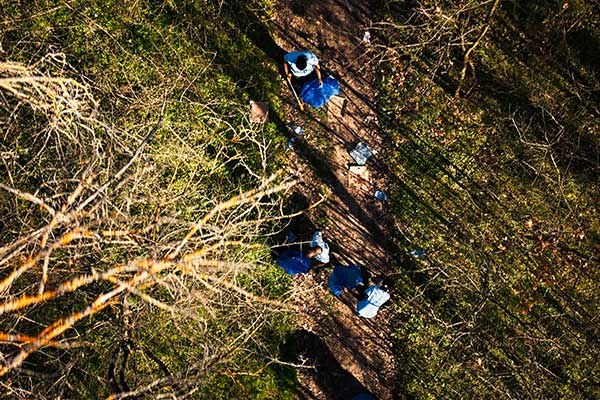
The mature trees on a Universal City lot are usually worth keeping and everything that has grown up underneath them usually is not. Underbrush clearing removes the second without touching the first. On a property where the back third has filled in with hackberry, ligustrum, and tallow, it is the service that gets the space back without losing the shade that makes the yard usable in August.
Out goes hackberry and chinaberry saplings, Chinese tallow, ligustrum, nandina spreading out of old beds, greenbriar, poison ivy, and volunteer growth crowding the base of better trees. Staying are the live oaks, post oaks, cedar elms, and anything planted deliberately that you want kept. We mark keepers with you before anything starts, and where a plant is ambiguous we ask rather than deciding on your behalf.
Almost none of what we remove on these lots was planted. Hackberry seeds itself into any corner nobody mows and reaches removal size within a handful of years. Chinese tallow has spread through the wetter parts of this area and reseeds heavily. Ligustrum was planted originally in many gardens and has since escaped into every unmaintained boundary. Catching these as saplings costs a small fraction of dealing with them as trees, which is the strongest argument for a maintenance interval rather than a decade of nothing.
On nearly every property here the problem began at the back fence. Nobody mows that strip, birds drop seed along it, and within a few years there is a row of hackberry and tallow growing through the fence and pushing the panels apart. Clearing it properly, including dealing with the stumps of the resprouting species, solves the vegetation problem and protects the fence at the same time, which is usually the cheaper of the two repairs.
The understory sits directly on the root zones of the trees you are keeping, and post oaks decline years after their roots are compacted. That means more of this work is done by hand here than an owner might expect, with material carried out rather than dragged, and machines kept on planned routes rather than wherever is convenient. It is slower, it costs more, and it is the reason the oaks are still there in a decade.
Oak wilt is present in Bexar County and live oaks are root grafted. Understory work should not be wounding oaks at all, but where a cut or scrape happens during the high risk window in late winter and spring it gets painted the same day. Post oaks are less prone to the rapid spread live oaks experience but remain susceptible and worth protecting from unnecessary wounds.
Hackberry, ligustrum, tallow, and chinaberry all resprout from the crown, and the seed source in surrounding properties remains regardless of what you do on your own lot. Full grubbing of crowns is often inappropriate under oaks because it disturbs roots you are protecting. That makes understory clearing a maintained condition rather than a permanent one, and a short return visit every year or two costs a fraction of the first clearing.
Open ground beneath the canopy with the fence line visible and reachable again. On a modest lot the usable area often increases noticeably once the back strip stops being a thicket, and the property photographs far better for a listing or a lease. Where light now reaches soil, ground cover generally recovers through the following season, and the deeply shaded areas become a simple decision about beds rather than a losing fight with turf.
There is no need to clear everything in one visit. Starting with the fence line and the area nearest the house handles the most pressing problems, and the rest can follow later. That spreads the cost, lets you see how much regrowth you are actually dealing with, and gives the oaks time between rounds of activity around their root zones, which on this soil is worth something on its own.
Underbrush clearing across Universal City, Selma, Live Oak, Schertz, Cibolo, Converse, Windcrest, Kirby, Garden Ridge, and neighbouring San Antonio areas.
Tell us which trees matter and what you want to be able to reach. Call 210-942-1961.
Selective removal of what grows beneath the canopy, leaving mature trees and soil intact. On a lot here that means taking out hackberry, ligustrum, tallow, chinaberry, and greenbriar while keeping live oaks and post oaks. It is very different from land clearing, which takes an area to bare ground including stumps.
Because nobody mows that strip and it is where birds drop seed. Hackberry, tallow, and ligustrum all establish there readily, and within a few years they are growing through the fence and pushing the panels apart. Clearing it properly solves the vegetation problem and protects the fence, which is usually the cheaper of the two repairs.
Now. Hackberry, tallow, and chinaberry reach removal size within a handful of years, and taking one out as a sapling costs a small fraction of removing it as a mature tree. Owners who stay ahead of volunteers spend far less over a decade than those who let them grow and then face several real removals at once.
Because the understory sits directly on the root zones of the trees you are keeping, and post oaks decline years after their roots are compacted. Hand work with material carried out rather than dragged avoids that. It costs more and takes longer, and it is the reason the oaks are still standing in a decade.
Where light now reaches the ground, often within a season, helped by the fact that the sandy surface soil here drains and warms quickly. Under dense canopy it may remain too shaded for turf regardless, in which case shade tolerant ground cover or a mulched bed is a more realistic plan than reseeding repeatedly.
Some of it, and the honest expectation is a maintenance interval. Hackberry, ligustrum, tallow, and chinaberry all resprout from the crown, and grubbing crowns under oaks is often inappropriate since it disturbs roots you are protecting. A short return visit every year or two costs a fraction of the first clearing.
Yes, and it is common here. Clearing the understory and the fence line makes a property show far better for a lease and reduces the ongoing maintenance a tenant is expected to manage. We can report by photograph to an owner who is not local and coordinate directly with a property manager if that is simpler.